

This week’s US tier one data matters much more than it did a month ago. Stronger growth would give the Fed more room to tighten. Firmer inflation would give it more reason.
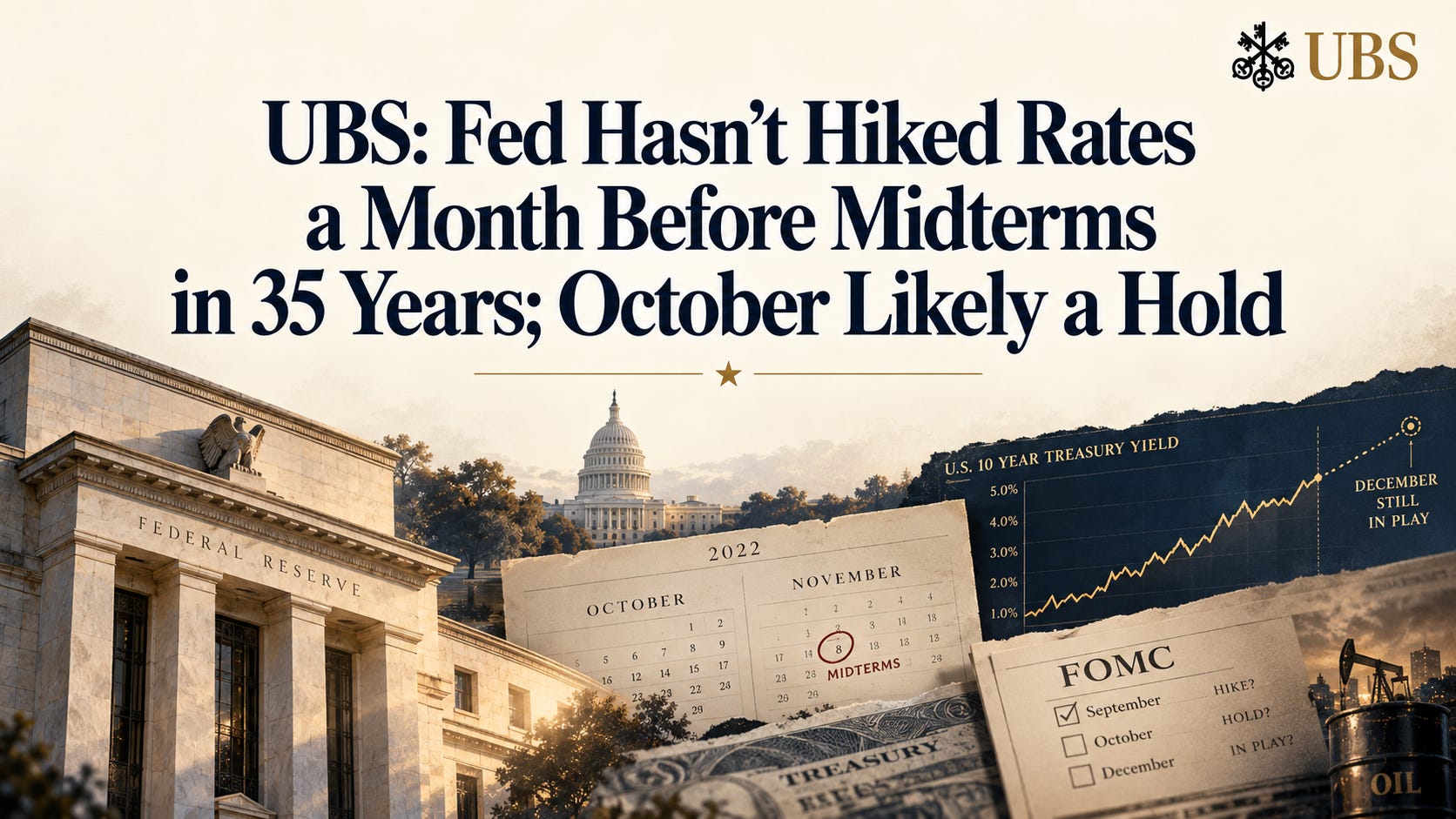
Yet UBS strategist Simon Penn wrote on Monday that markets were assigning roughly a 68% probability to another rate hike next month, while arguing that investors may also be underestimating the scope of policy restraint ahead of the midterms.
Takeaways by Dark Side of the Boom™
Oil and rates are squeezing the market from opposite ends. Energy is keeping inflation pressure alive while higher real yields raise the cost of money.
The Fed may still have room to tighten. Strong growth is not helping the dovish case.
October may be the wrong meeting to focus on. UBS argues the tightening risk may simply be pushed further down the strip rather than disappear.
Equities have already absorbed a meaningful valuation reset. That creates upside asymmetry if yields finally stabilize or roll over.
The next move depends on whether energy cools before rates bite harder. If not, the pressure now sitting in bonds could migrate more aggressively into stocks.
The Dark Side of the Boom™ question is simple: does oil peak in time to give equities some breathing room, or does the Fed get enough runway to turn the rates squeeze into something much uglier?
October Likely a Hold?
Macro pressure is coming from both sides now. Brent is pushing toward $106 while the 10-year Treasury yield sits near a two-decade high, leaving traders staring at the same uncomfortable question: how much more energy-driven inflation can the Fed tolerate before another hike moves from tail risk to base case?
This week’s US tier one data matters much more than it did a month ago. Stronger growth would give the Fed more room to tighten. Firmer inflation would give it more reason.
Yet UBS strategist Simon Penn wrote on Monday that markets were assigning roughly a 68% probability to another rate hike next month, while arguing that investors may also be underestimating the scope of policy restraint ahead of the midterms.
From a Dark Side of the Boom™ perspective, October may be politically awkward, but there is not much joy in simply pushing the pain into December either. A Fed rate hike landing just before Christmas is still a lump of coal in the market’s holiday stocking.
That is the nasty part of the setup.
Oil is keeping the inflation problem alive, growth is keeping the Fed’s hands free, and the bond market is making sure nobody forgets the bill.
Penn’s pushback is almost entirely about timing rather than direction.
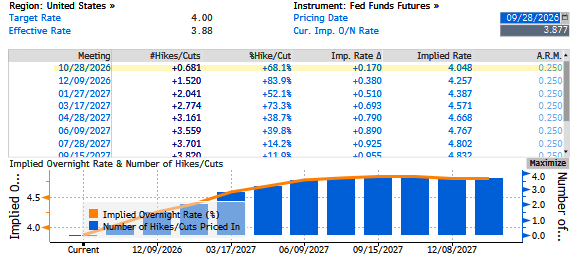
His argument is that the market may be too eager to drag the next hike into October 28. The curve is pricing roughly 17.4bp, or about a 69% chance of another move, but Penn points to a striking historical pattern: since 1990, the Fed has not raised rates at an October meeting immediately ahead of a November election. Even September hikes in election years have been rare, with only 2004, 2018 and 2022 fitting the bill.
That does not mean Penn suddenly turns dovish. Quite the opposite.
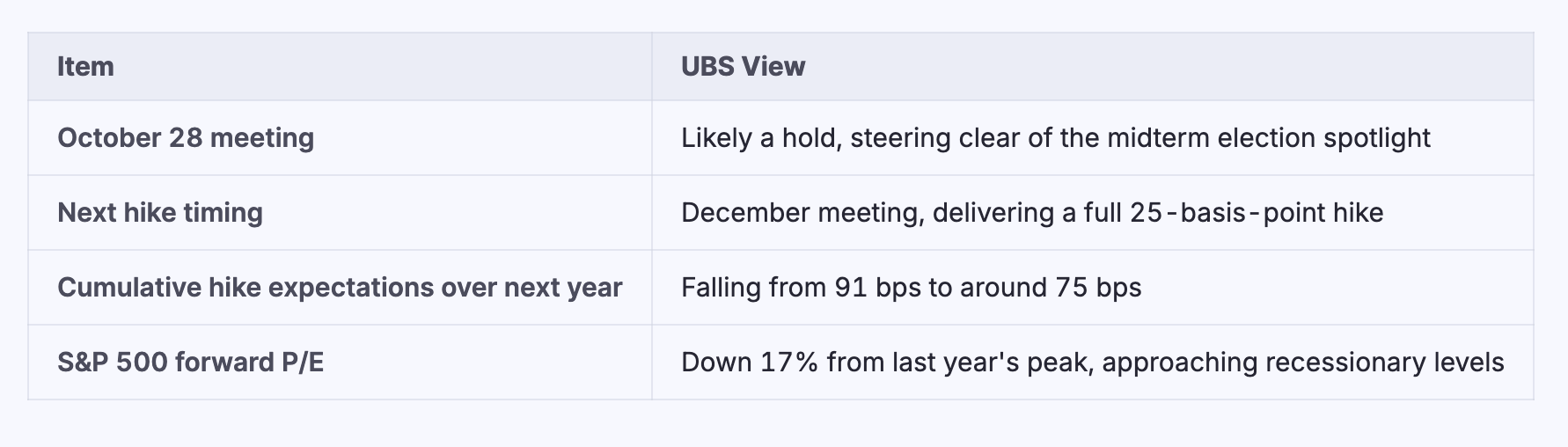
His point is that if October comes out of the frame, the tightening should be pushed further down the strip rather than erased. December should sit closer to a full 25bp, with the balance distributed into January and March, while the longer dated pricing should be faded from roughly 91bp of cumulative hikes over the next year toward 75bp.
In other words, Penn is not arguing that the Fed is finished. He is arguing that the market may have the right movie but the wrong scene order.
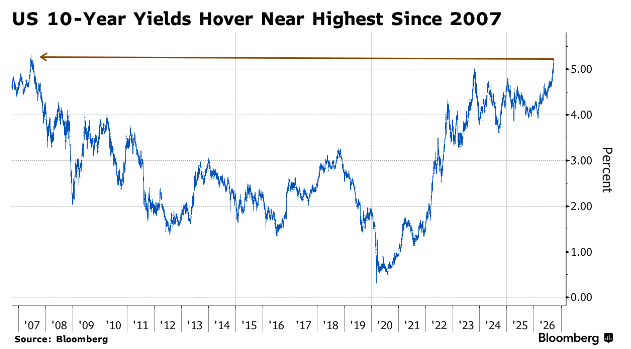
And the bond market is hardly waiting around for the scheduling debate to settle. US 10 and 30 year yields opened the week at their highest levels since 2007 and 2004, respectively.
The tightening story is still alive. The fight is increasingly about when the next punch lands.
UBS markets analyst Nana Antiedu, citing US equity strategist Keith Parker, makes the case that a lot of the rates damage has already been forced through the equity multiple.
Even if October likely avoids a hasty hike, elevated borrowing costs are already exerting tangible pressure on US equities. UBS US equity strategist Keith Parker warns that the 10-year Treasury yield has jumped roughly 100 basis points in a year, rapidly wringing valuation froth out of equity assets.
Parker notes that the S&P 500’s forward 12-month P/E has pulled back 17% from last year’s peak — a drawdown approaching recessionary levels and closely resembling the aggressive tightening cycle of 1994. Historical analysis shows that once cumulative rate hikes exceed 100 basis points in a single year, the broader market typically struggles to hide its fatigue.
The S&P 500’s next twelve month P/E has fallen roughly 17% since November, while the 10 year Treasury yield has climbed about 100bp year to date. Parker says the derating is now approaching levels normally associated with recession scares and looks increasingly comparable with the 1994 tightening cycle.
That is important because the market may already have paid a decent chunk of the valuation bill.
From here, Parker argues the Fed path matters more than the absolute level of yields. When rates stabilized without an aggressive tightening cycle, the S&P 500 historically went on to deliver double digit returns over the following year. When the Fed pushed through more than 100bp of hikes inside twelve months, equity returns were typically flat to negative.
The interesting part is the asymmetry. Parker sees more upside if yields fall than downside if they grind somewhat higher, which leaves investors positioned for rates to stay elevated while retaining optionality to any genuine bond market relief. UBS highlights semis, pharma, refining and diversified banks as subindustries that still screen well while carrying less rates sensitivity.
Below is UBS's core assessment of the Fed's policy path:
Goldman adds another wrinkle. Historically, stocks have tended to run into resistance when the 10 year yield rises about 30bp in two weeks or 50bp in a month. We are already close to the first threshold, with yields up roughly 28bp since September 9, and 37bp since August 21.
So the market is approaching the point where the bond selloff stops being background noise and starts demanding a response.
Equities have already swallowed a lot of the rates medicine. The question now is whether the next dose finally becomes toxic.
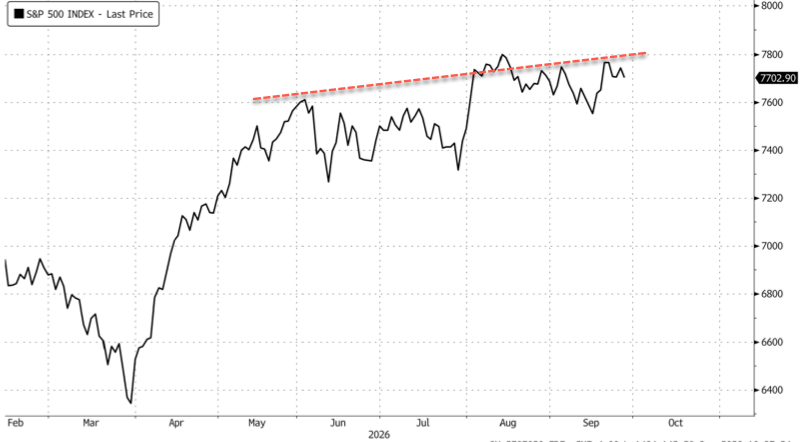
What is clear is that the market is now trapped between an energy shock on one side and a Fed with more runway on the other.
The bullish case is not complicated. If oil finally peaks, yields stop climbing and the geopolitical temperature cools, then a market that has already swallowed a fair amount of valuation pain suddenly has room for a violent relief rally. That is the door the bulls are staring at.
But the other side of the trade is just as clean. If energy stays expensive, the data refuse to roll over and the Fed keeps tightening, then the pressure simply migrates from bonds into equities.
This is no longer a market arguing about whether rates matter. It is arguing about whether oil and growth give the Fed enough time to make them matter a lot more.
The October timing point is useful, but JOLTS and PCE arrive before that meeting. Cooler hiring alongside sticky inflation would make the December-versus-October debate considerably messier.