

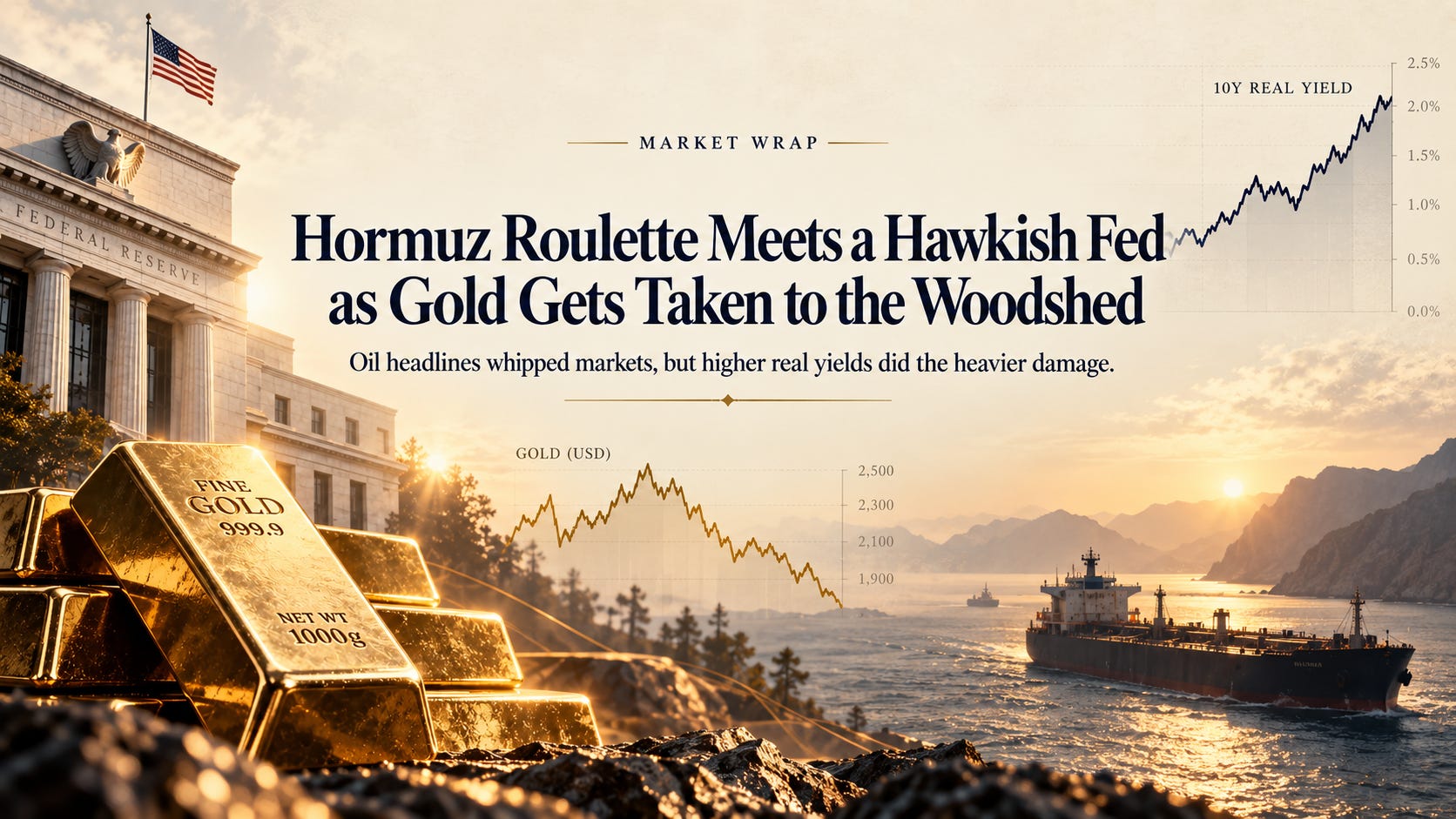
Gold was the standout casualty, and as I suggested in the Gold Market Weekly, traders were likely to walk through the Monday door selling bullion. That was never some crystal ball call. It was simply reading what the bond market was already telling us. The bulk of the recent rise in Treasury yields has come from investors repricing a stronger US economy and a more aggressive Fed path, while inflation breakevens have hardly moved and real yields have done the heavy lifting.
If you are wondering where the usual Asia bid disappeared to, look no further than the same toxic cocktail already weighing on bullion: a hawkish Fed, rising real yields and a Shanghai market heading for the shutters. Long positions on the Shanghai Futures Exchange were trimmed ahead of the National Day holiday, and with the market then closing for a full week, that pre-holiday liquidation removed another layer of support as liquidity turned nonexistent. Gold was already skating on thinner ice; Asia simply stopped throwing it a rope, amplifying the moves in Asia.
Takeaways by Dark Side of the Boom™
Hormuz headlines are whipping oil around, but real yields are doing the heavier damage across capital markets.
Stocks are beginning to feel what a genuinely higher cost of capital means, with long-duration tech taking the bigger hit.
Gold has nearly delivered the full $200 weekly downside range I flagged in barely 24 hours.
The bond selloff is increasingly about a strong economy and a more hawkish Fed, not simply another inflation scare.
PCE and payrolls now decide whether Monday was the warning shot or the start of a much larger repricing.
The question for Dark Side of the Boom™: If oil keeps feeding the inflation problem while the US economy refuses to buckle, how long can equities keep pretending that a rising cost of money belongs to somebody else?
Gold Gets Taken to the Woodshed
In my Wall Street Week Ahead note, I warned that this was shaping up to be one of those weeks where geopolitical headline ping-pong would collide with a data calendar already carrying enough explosives of its own. Barely 24 hours into the trading week, we have already had enough “deal or no deal” headlines around the Strait of Hormuz to make even the most battle-hardened macro trader seasick. Oil has been whipped around like a loose deck chair in a storm, Treasury yields have pushed higher again, equities have turned defensive, and gold has been taken to the woodshed, all before the real macro heavyweights have even stepped into the ring.
That last point matters because PCE is still sitting in the middle of the road on Wednesday and payrolls are waiting at the end of the week. Those were always the major macro gatekeepers, yet markets have already arrived at them carrying a fresh geopolitical risk premium, an increasingly hawkish Fed repricing, and a bond market that seems determined to find out just how high the pain threshold really is.
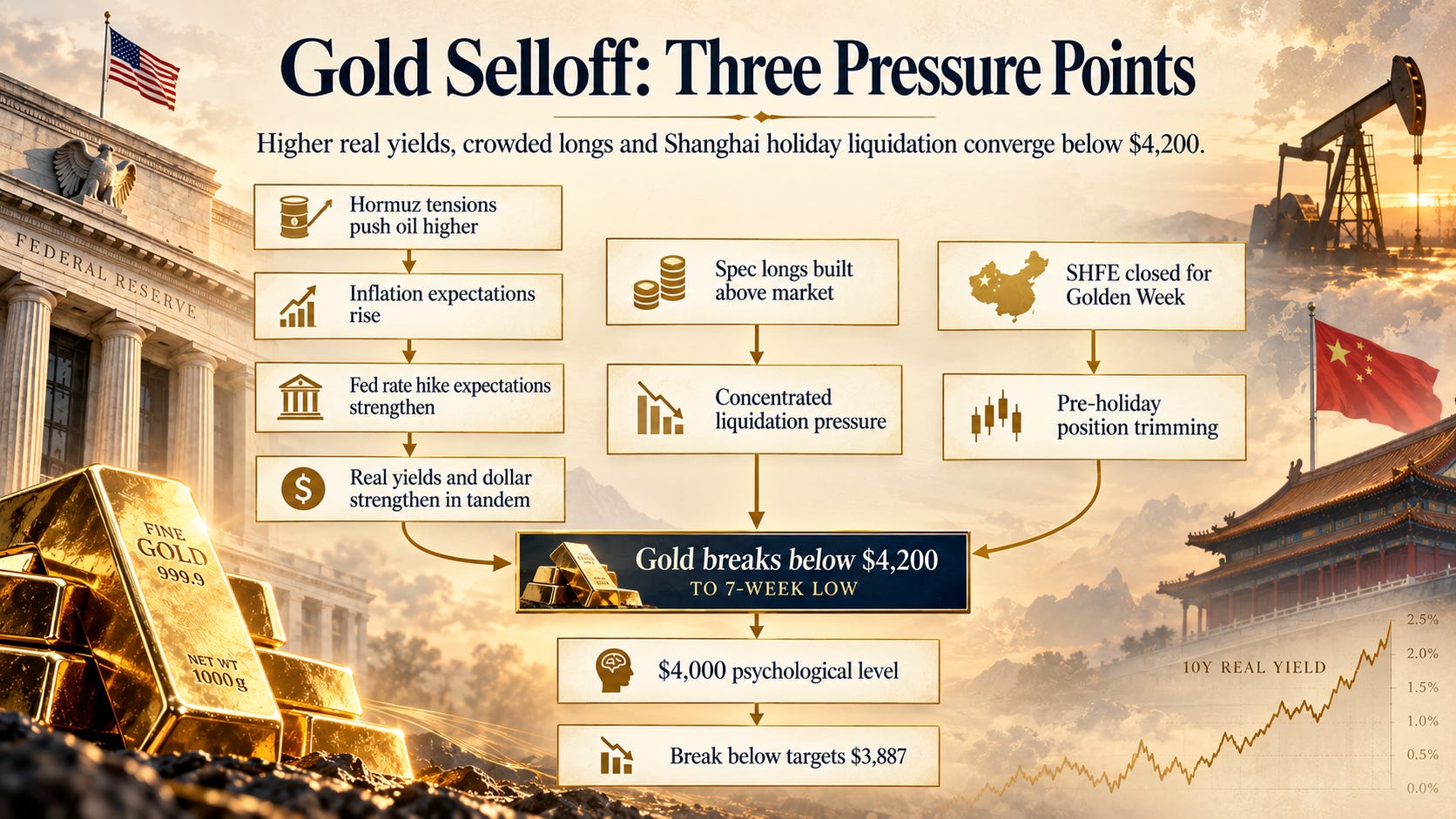
Gold was the standout casualty, and as I suggested in the Gold Market Weekly, traders were likely to walk through the Monday door selling bullion. That was never some crystal ball call. It was simply reading what the bond market was already telling us. The bulk of the recent rise in Treasury yields has come from investors repricing a stronger US economy and a more aggressive Fed path, while inflation breakevens have hardly moved and real yields have done the heavy lifting.
If you are wondering where the usual Asia bid disappeared to, look no further than the same toxic cocktail already weighing on bullion: a hawkish Fed, rising real yields and a Shanghai market heading for the shutters. Long positions on the Shanghai Futures Exchange were trimmed ahead of the National Day holiday, and with the market then closing for a full week, that pre-holiday liquidation removed another layer of support as liquidity turned nonexistent. Gold was already skating on thinner ice; Asia simply stopped throwing it a rope, amplifying the moves in Asia.
That distinction is everything, and in barely 24 hours since the open, gold has almost delivered the entire $200 downside range I had pencilled in for the week on my weekly call. That tells you how violently this particular rates regime is colliding with the bullion market.
The speed and sheer volume of the selling has all the hallmarks of a crowded house rushing for the exits, and that is now creating some severely oversold conditions. But the absence of the usual Chinese bid this week is not a signal I would casually throw in the bin. Nonetheless, we are moving closer and closer to nibble on the bid territory.
But stocks deserve their usual place near the front of the Market Wrap because they are beginning to show us where the higher cost of capital is finding flesh.
The scoreboard was simple: oil up, yields up, stocks down. Crude got tossed around by Hormuz headline roulette, but stocks and bonds eventually stopped biting on every diplomatic feint.
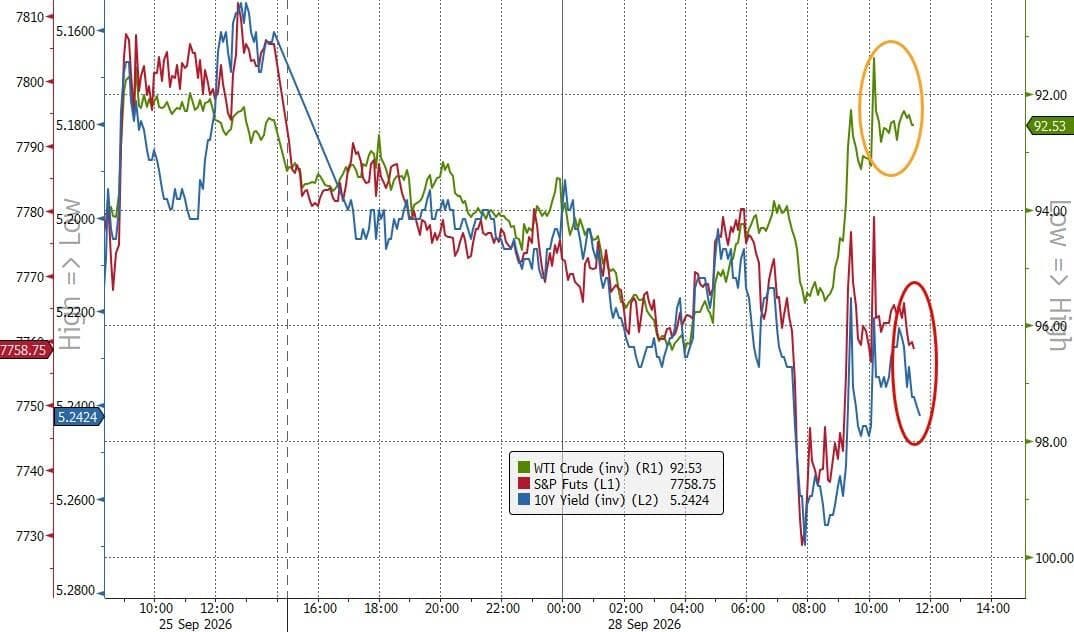
The major US indices finished lower, led by the Nasdaq, which had rebuilt length in crowded fashion, with the Nasdaq 100 down about 1.1% as longer-duration assets took the heavier punches. The S&P 500 wiped out its monthly advance, and beneath the surface the market looked considerably less comfortable than the headline index moves might suggest. For the 10th consecutive session, and 14 of the past 15, new lows on the NYSE outnumbered new highs, which is not the sort of breadth you normally associate with a market strolling confidently toward the next record.
Activity was relatively quiet early in the session, but the underlying flow had a distinct sell skew. Hedge funds were roughly 24% better for sale, led by macro products and semiconductors, while long only accounts were around 25% better for sale, particularly across macro products and technology. Defensives did what defensives are supposed to do when investors start checking the exits, with staples and healthcare holding up better while discretionary, financials and technology lagged.
This is where the rates story starts climbing directly inside the equity story.
AI has shrugged off a remarkable amount of macro noise because earnings enthusiasm, enormous capital expenditure commitments, and the perception of structural scarcity kept investors willing to look past the cost of money. But when real yields keep grinding higher, even the most exciting long duration story eventually has to answer the same question every other asset answers: what is that future cash flow worth today?
Agentic AI underperformed and gave back some of the gains from the recent Muse excitement, while AI names more broadly lagged the S&P excluding AI, and non-profitable technology was hit hard. Hyperscaler credit default swaps continued to widen, and even the mega caps, initially helped by Nvidia’s enormous buyback, saw selling accelerate into the final hour.
This is not yet an AI collapse story. It is a cost-of-capital story, and that is a much more important distinction because bubbles can ignore valuation longer than most traders can remain solvent trying to short them. The risk-free rate, however, is not an opinion. When the hurdle rate rises month after month, the arithmetic eventually starts knocking on the door.
10-year Treasury yields have now risen for 7 straight months. Real 10-year yields are breaking toward levels not seen since the Lehman era, while the nominal 10-year has pushed into territory not seen for nearly 2 decades. At some point, the AI complex has to stop asking only how much revenue the next generation of compute can create and start asking how much it costs to finance the road getting there.
That is where widening hyperscaler CDS becomes interesting. Credit is often the relative at the family dinner who notices the smoke in the kitchen before everyone else smells it. Equity investors can keep talking about terminal growth and addressable markets, while credit investors eventually ask who is paying the bill.
For now, the answer is still that the largest technology companies have enormous balance sheets and cash flows, but the direction of travel matters. If the cost of capital keeps rising while capex keeps exploding, the conversation starts shifting from how much AI can earn to how expensive the bridge to those earnings becomes.
The bond market is forcing that conversation.
Treasuries sold off another 7 to 8 basis points across much of the curve as oil remained elevated and investors added to expectations for additional Fed tightening. 10-year yields touched their highest levels since 2007, while real yields continued their breakout, and swap markets are now fully pricing at least 3 more 25 basis point hikes over the next 12 months, with the possibility of a 4th.
That is a very different world from the one equity investors were living in only months ago, and again I would resist the temptation to explain the whole move through oil.
Oil has part of the steering wheel, absolutely. Higher energy prices complicate the inflation story and give the Fed less room to relax, but the bigger issue is that the US economy has simply refused to roll over. Resilient growth and a strong labour market continue to give the Fed room to stay restrictive, and this week’s data could reinforce that case.
Wednesday’s numbers are expected to show inflation-adjusted consumer spending rising strongly in August. The Fed’s preferred underlying inflation gauge may receive some help from methodological revisions on the annual number, but the month-to-month picture is expected to remain considerably less soothing. Then payrolls arrive Friday, with consensus around 90,000 jobs for September and unemployment holding near 4.1%. That is hardly an economic collapse, and another resilient labour report could hand the rates market exactly the ammunition it needs to keep pushing the Fed path higher.
Then we arrive at crude, where the market appears to have handed the steering wheel to headline-reading algorithms and thrown the map out the window.
This was geopolitical headline roulette in its purest form. Oil began the session firmer after President Donald Trump rejected Iran’s 7-day proposal. Then reports emerged that Saudi Arabia had restarted oil exports through its repaired East-West pipeline, and crude moved lower. Explosions were then reported in Yanbu, Jazan and Najran, and oil jumped, only for reports that Trump could be open to sanctions relief and the release of frozen Iranian assets in exchange for progress on the nuclear issue to knock it lower again.
Then Iranian officials reportedly turned pessimistic about a deal ahead of the US midterms and crude bounced. Another headline suggested Iran might halt enrichment in exchange for sanctions relief, and oil fell. Then another US source said the gaps remained wide and the obstacles significant, and back up we went.
At a certain point you stop trading fundamentals and start playing geopolitical whack-a-mole.
Humans are not reacting to these headlines at the speed the futures market is moving. Machines are. The result is a crude market where every fragment of diplomatic language becomes a temporary trading signal before anyone has had time to decide whether it actually changes the probability of barrels moving through Hormuz.
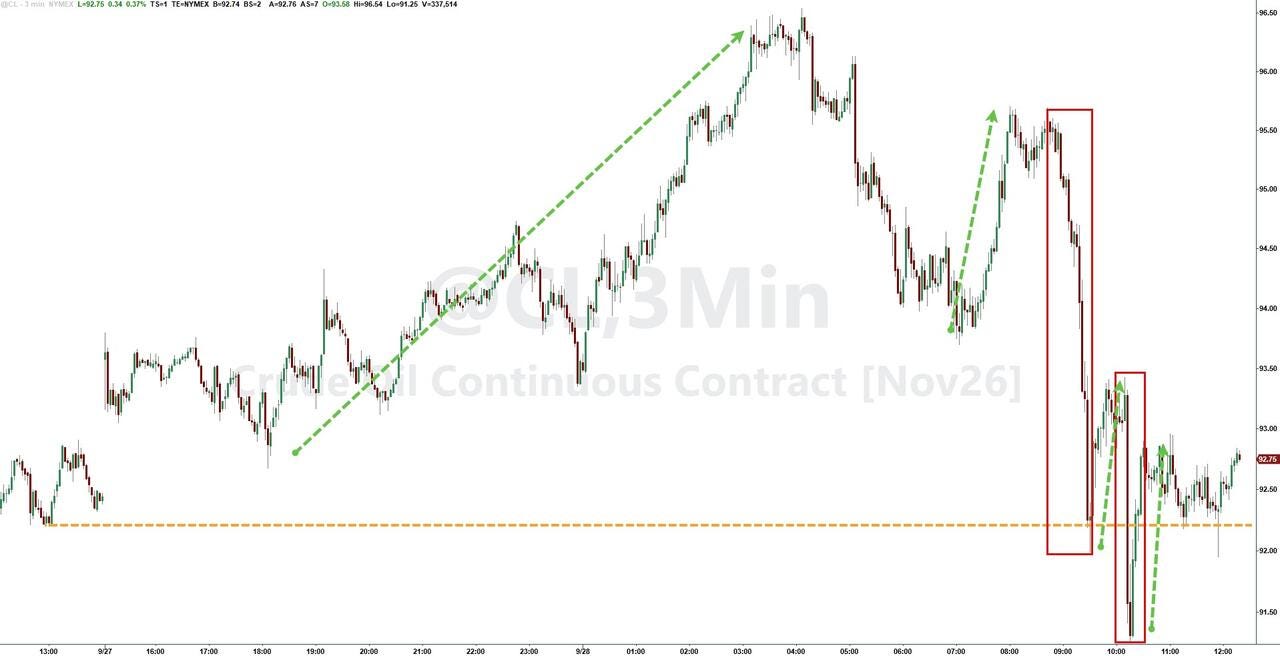
This is why I have been warning about headline ping-pong. It does not mean every headline is meaningless. It means the market will continually overshoot the informational content of many of them before snapping back.
Brent ultimately remained around $105 even after giving back part of its rally, and that itself tells us something. Despite all the noise, traders are not pricing an imminent diplomatic breakthrough, but neither are they pricing a permanent closure of the Strait. We remain somewhere in the uncomfortable middle.
The more uncomfortable possibility is that this conflict remains embedded in markets for some time, forcing the global economy to keep adjusting to disrupted oil flows and leaving a much firmer floor underneath energy until Hormuz genuinely reopens.
That floor matters because even if oil does not explode higher, merely staying elevated for long enough starts feeding into real income and eventually demand destruction. Traders may be spending too much time buying and selling yields on each Iran headline while missing the larger issue: commodity prices staying high for long enough eat into real household income.
That is eventually where the inflation story mutates into a growth story.
For now, however, the Fed is looking through the front windshield rather than the rear view mirror. As long as growth and employment remain resilient, elevated energy costs simply make the inflation side of the mandate harder, and that keeps the hawkish trade alive.
The dollar benefited, although the move was hardly explosive. Higher yields pulled the greenback back toward Friday’s highs but did not generate the sort of runaway dollar rally that would suggest markets had suddenly discovered an entirely new macro regime. That makes sense because much of the US relative growth story is already known. The question now is whether PCE and payrolls deliver enough additional evidence to justify another material leg higher in the rates structure.
Crypto spent the day doing its usual impression of a high beta weather vane. Bitcoin was hit overnight alongside gold, traded down toward $82,500 and then bounced sharply as risk sentiment recovered on another round of diplomatic hope, eventually finishing only marginally lower from Friday.
The fact that gold and Bitcoin initially sold together is instructive. Neither was being treated as an escape hatch from the macro story. Both were being hit by the same combination of tighter financial conditions and de risking.
But perhaps the strangest feature of the entire session is how little panic is still priced into equity options.
Equity volatility remains remarkably subdued considering what is happening underneath the hood. Sector and single stock correlations remain low, 6-month realised correlation among the largest S&P sectors is sitting near levels last seen around 2017, short dated implied volatility remains historically depressed and volatility of volatility is similarly restrained.
That is why the index can look relatively calm while whole pockets of the market are being kicked around behind the curtain. Tech weakness is offset by defensive strength, some mega caps hold while other speculative corners get sold, and sector moves cancel one another out. The index becomes the duck floating calmly across the pond while its legs are paddling furiously underneath.
That works until correlation rises.
If oil volatility feeds another jump in rates volatility and investors suddenly decide they need protection at the same time, the benign index level picture can change very quickly. Cheap hedges are cheap because nobody desperately wants them. Once everybody wants them, they have a nasty habit of becoming expensive before the buyer reaches the front of the queue.
The S&P also looks tactically fragile around 7,700, with 7,800 acting as an important overhead level and the negative gamma backdrop capable of making the index considerably less well behaved if selling gathers pace. That does not mean a crash is hiding behind every tick. It means the market’s calm increasingly depends on rates behaving themselves, and right now rates are not behaving themselves.
There is another wrinkle here. Bonds themselves are beginning to look materially more attractive relative to equities than they have in years, which raises the hurdle for stocks twice. First, higher yields reduce the present value of future earnings. Second, investors suddenly have a credible alternative.
When bonds yielded almost nothing, equity investors could tolerate heroic assumptions because the alternative was financial purgatory. At today’s yields, Treasuries actually compete for capital, which makes the rosy earnings projections embedded in equity valuations more important than ever.
If profits deliver, stocks can continue to grind through higher yields. If profits disappoint, there is no longer a zero yielding bond market waiting underneath equities like a mattress.
And that gets us back to where we started.
Monday felt violent because several markets moved at once, but in many ways it was simply the opening hand. We still have PCE, we still have payrolls, we still have a Fed being given increasingly strong reasons to keep its foot on the brake, we still have oil north of $100, and we still have Washington and Tehran firing headlines into a market whose algorithms appear willing to chase every diplomatic comma.
The geopolitical roulette will continue. Some headline will probably send crude sharply lower, another may send it straight back up 20 minutes later, but beneath all that noise sits the more durable macro question: does the US economy finally give the bond market a reason to stop marking rates higher?
If PCE runs firm and payrolls remain robust, investors may discover that Monday was not the selloff.
It was the market stretching before the race.
Gold has already found out what happens when the market stops fearing inflation and starts fearing the Fed response to it.
Equities are only beginning to ask the same question.