


The interesting thing about gold right now is that the strongest buyers may also be the least interested in what happens over the next few weeks. China is securing physical metal, refinery capacity is tightening and the structural reasons for holding bullion remain largely intact. But the financial market has just experienced a painful reminder that even a good long-term investment can become a very bad short-term position when leverage starts coming out.
Takeaways by Dark Side of the Boom™
• UBS sees gold caught between exhausted speculative positioning and persistent physical demand, with traders reluctant to rebuild exposure after last week’s punishing liquidation.
• The heaviest selling was concentrated in a single session, but physical buying from China has continued, with demand for kilobars arriving earlier than usual and refinery capacity becoming increasingly difficult to secure.
• UBS technical strategist Jason Perl has shifted bullish following completion of his minimum correction target, although the market still needs to clear $4,082.80 to confirm a more convincing recovery.
• Silver remains considerably less reassuring, with UBS maintaining a neutral technical outlook and warning that price action remains unusually sensitive to headlines and positioning.
Gold’s $4,082 Question
Gold has reached one of those uncomfortable moments when almost everyone still likes the longer-term story, but remarkably few traders seem prepared to put additional money behind it. The structural arguments remain familiar enough: central-bank diversification, geopolitical uncertainty, demand for alternatives to the dollar and persistent physical buying from Asia. Yet the market has just demonstrated that none of those arguments offers much protection when institutional investors suddenly decide they need liquidity more than another ounce of bullion.
The damage from last week’s liquidation has left an obvious mark on positioning and confidence. Gold has struggled to regain momentum despite a macroeconomic backdrop that would ordinarily have been more supportive, and the reluctance to rebuild risk has become almost as important as the selling itself.
That is the central message from UBS’s latest Bullion Report, aptly titled Structural Support, Tactical Caution.
The bank’s precious-metals sales desk describes a market where buying interest remains meaningful near the lower end of the range, but conviction is conspicuously absent. New York activity has become unusually subdued, afternoon trading ranges have narrowed, and investors who were previously happy to chase the rally are now more interested in protecting what remains of their annual performance.
From a trading perspective, that distinction matters enormously. A market does not need to lose its fundamental support to become difficult to own. Sometimes it simply runs out of investors willing to defend the next ten or twenty dollars of downside.
And that appears to be where gold finds itself.
The Liquidation Was Real, but the Selling Has Changed Character
UBS’s electronic trading data provide a particularly revealing account of last week’s washout.
October 22 accounted for approximately 26% of the entire week’s electronic XAU/USD cash turnover, with gold under sustained pressure throughout much of the session as prices slipped below $4,050 for the first time since August.
Every major client segment recorded its heaviest trading activity that day, while asset managers concentrated roughly 30% of their weekly turnover into that single session.
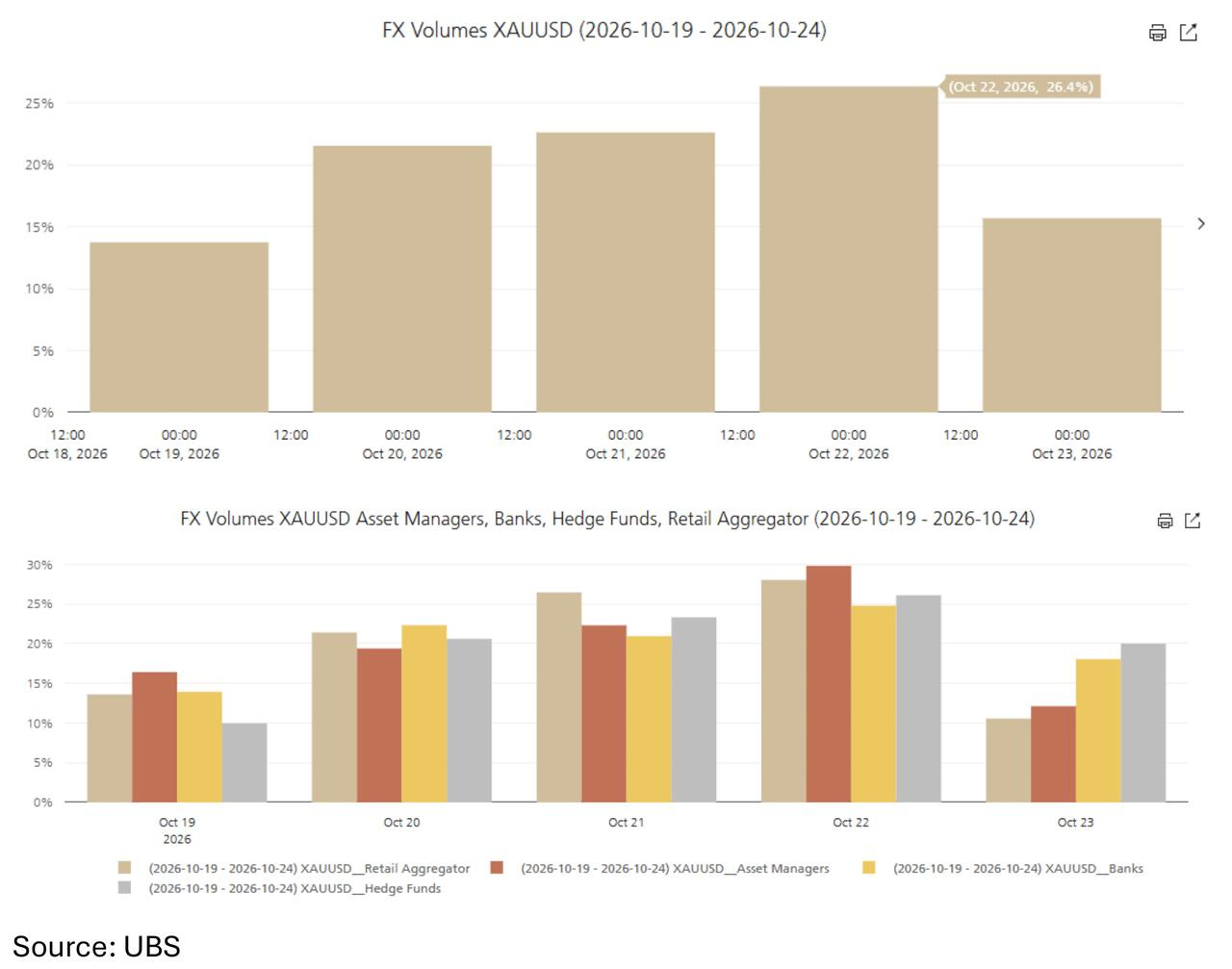
That is the sort of concentration one normally associates with an abrupt repositioning rather than a gradual change in fundamental expectations.
The importance is not simply that investors sold gold. It is that the selling arrived across multiple client groups at almost exactly the same time, suggesting the pressure was being driven by a broader need to reduce exposure rather than a coordinated reassessment of the metal’s long-term investment appeal.
And once those positions were cut, the market became remarkably quiet.
UBS notes that volatility-focused traders have largely moved to the sidelines because the subsequent trading environment has offered little opportunity to establish meaningful positions. Discretionary investors, meanwhile, are increasingly reluctant to rebuild exposure ahead of year-end.
There is an important distinction between a market that has exhausted its buyers and one whose former buyers have temporarily lost their appetite for risk.
Gold’s current behaviour looks much closer to the latter.
The sharp decline has clearly damaged confidence, but UBS continues to observe buying interest whenever prices approach the lower end of the range. That has prevented the selling from developing into a more convincing breakdown, even as the market struggles to generate sufficient momentum to sustain a recovery.
In other words, the bears have not established control, but the bulls have yet to rediscover their nerve.
The Physical Market Is Telling a Different Story
The most interesting part of UBS’s research is not coming from New York’s increasingly quiet trading screens.
It is coming from Asia, where demand for physical bullion has remained firm despite the volatility in international prices.
UBS reports continued buying of kilobars destined for mainland China, alongside demand for larger bars. More importantly, this activity began around the start of October and has remained consistent, arriving earlier than the bank has typically observed in recent years.
That is significant because physical demand tends to operate on a very different timetable from speculative investment flows.
A hedge fund can liquidate a position in seconds. Physical bullion buyers, particularly those acquiring metal for longer-term holdings, are often less concerned with the next intraday price fluctuation than with availability, premiums and the ability to secure delivery.
And according to UBS, those physical constraints are beginning to matter.
Refinery production orders are becoming more difficult to arrange, with available refining slots tightening as demand for kilobars continues.
That is an important distinction for traders who spend most of their time watching the electronic market.
A futures price may suggest gold is struggling to attract buyers, while the physical market can simultaneously be experiencing strong demand for particular bar sizes and delivery locations.
The two are not contradictory. They reflect different investors operating with different objectives, financing requirements and time horizons.
UBS also notes emerging interest in settling some physical transactions against the renminbi rather than exclusively against the US dollar.
That does not establish a wholesale shift away from dollar-based bullion trading, but it is another indication of how China’s role in the physical market is evolving.
For years, the strategic argument for owning gold has centred on diversification away from traditional reserve assets and the broader uncertainty surrounding the international monetary system.
UBS’s latest observations suggest that demand associated with those considerations remains active, even as shorter-term investors continue reducing exposure.
And this is why I would be reluctant to interpret the recent liquidation as evidence that the structural gold story has suddenly fallen apart.
The physical buyers appear considerably less distressed than the financial investors.
But there is a catch.
Persistent physical demand can help absorb selling and establish support. It does not necessarily create the immediate speculative momentum required to push prices substantially higher.
For that, gold probably needs a change in the technical picture.
UBS’s Jason Perl Has Turned Bullish, but $4,082.80 Is the Gatekeeper
The most consequential change in this week’s UBS report comes from Jason Perl’s DeMark technical analysis.
Perl had previously maintained a cautious view on gold, looking for an ABC correction to satisfy the technical conditions necessary for a more constructive assessment.
According to the bank, those minimum requirements were met on October 23 at $3,996.10.
That has shifted Perl’s technical outlook to bullish.
But there is an important difference between completing a corrective pattern and confirming that a sustained recovery is underway.
Perl identifies $4,082.80 as the immediate upside threshold.
A convincing move above that level would strengthen the recovery case and bring a sequence of higher technical objectives into focus.
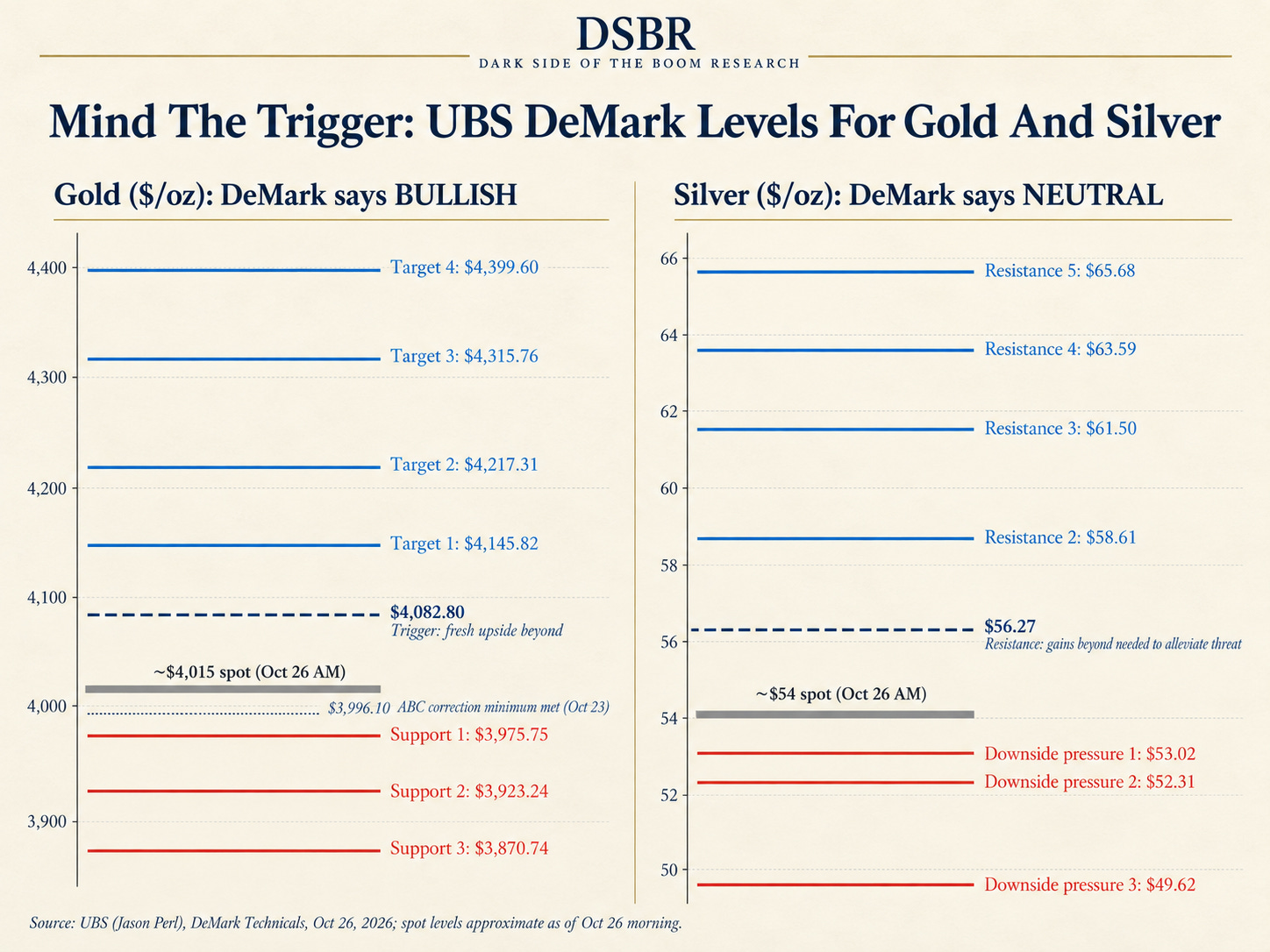
These levels are particularly useful because they provide an institutional and disciplined framework for navigating a market that has become unusually difficult to interpret through conventional macroeconomic relationships.
The physical demand picture remains supportive, but the speculative market has not yet demonstrated the confidence required to sustain an advance.
A recovery through $4,082.80 would begin changing that assessment.
Failure to regain the level, particularly if accompanied by renewed institutional selling, would leave the market vulnerable to another test of the support zone.
For my money, the attraction of Perl’s analysis is that it separates the longer-term investment argument from the immediate trading decision.
There is no need to declare the entire gold bull market finished simply because prices have experienced an ugly liquidation.
Equally, there is little reason to confuse persistent physical demand with confirmation that the correction has run its course.
The price still needs to do some work.
Silver Is Not Sending the Same Message
UBS’s assessment of silver is noticeably less constructive.
While gold has completed the minimum requirements for a bullish DeMark interpretation, silver remains technically neutral, with near-term risks still tilted toward further weakness.
The distinction is understandable.
Silver has a more pronounced industrial component, and its price action can become particularly vulnerable when investors are simultaneously questioning economic growth, financing conditions and the outlook for manufacturing demand.
UBS reports that silver experienced an unusually aggressive reaction to recent headlines despite limited evidence of a comparable deterioration in underlying fundamentals.
Last Friday, silver traded near $53 before recovering some of its losses, with electronic volumes heavily concentrated into the session.
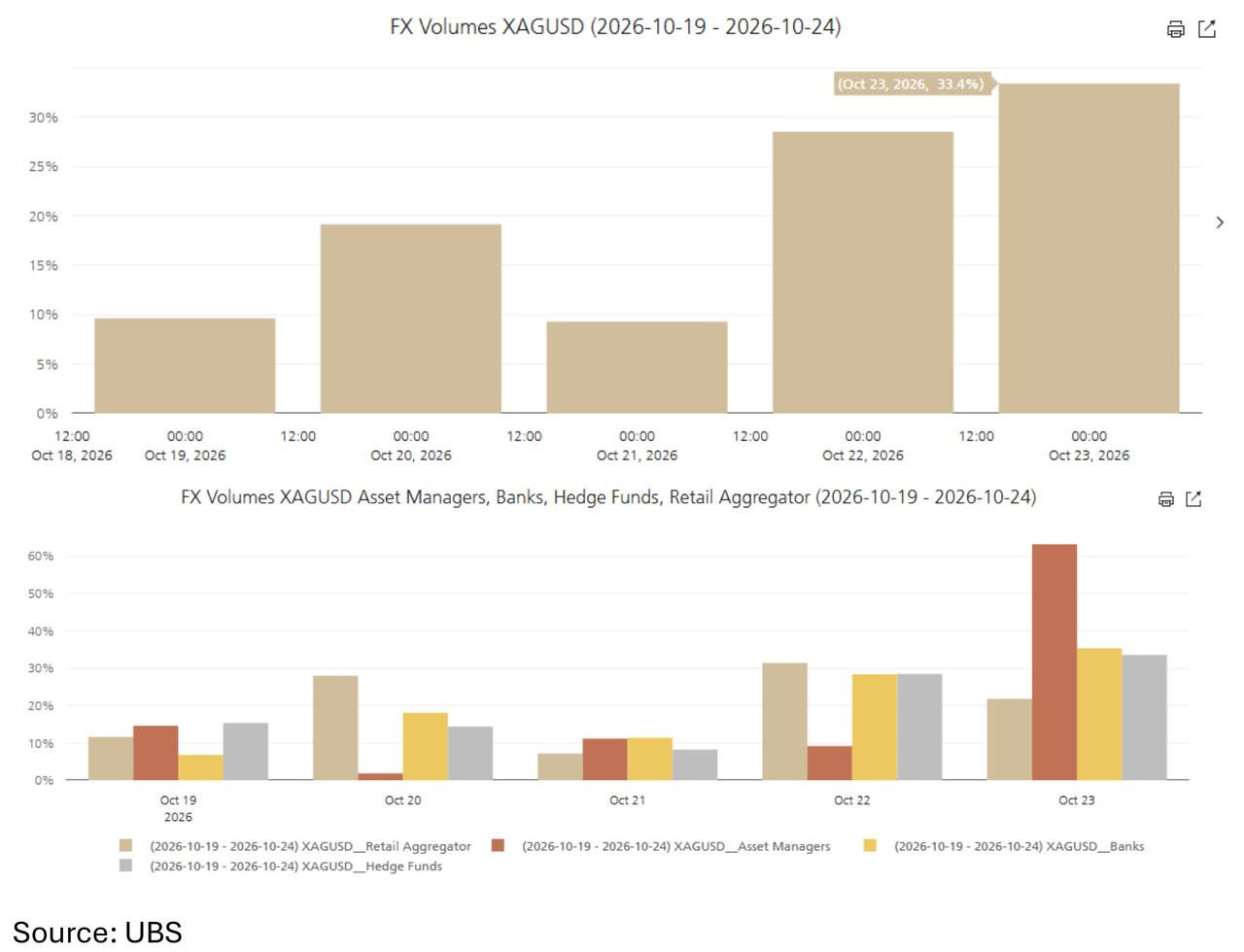
Asset managers conducted more than 60% of their weekly silver turnover on that day, while banks and hedge funds also registered unusually concentrated activity.
Those numbers tell you how sensitive the market has become to positioning.
Perl identifies $56.27 as the level silver must recover to reduce its immediate downside vulnerability.
Until that happens, support around $53.02, $52.31 and $49.62 remains relevant.
The contrast with gold is important because precious metals are often treated as a single investment theme, particularly during periods of broad speculative participation.
But the current market is increasingly distinguishing between gold’s monetary and reserve-asset characteristics and silver’s greater sensitivity to industrial activity and speculative volatility.
That argues against assuming a recovery in gold will necessarily produce an equally convincing advance in silver.
Tight Spreads, Quiet Screens and a Market Waiting for Its Next Catalyst
One of the more revealing details in UBS’s report is that the decline in trading conviction has not been accompanied by a deterioration in normal electronic market liquidity.
Average top-of-book XAU/USD spreads during October 19–24 were approximately 5% tighter than the earlier October average and 11% tighter than September.
That tells you something important about the current environment.
The market is not necessarily struggling because dealers are unwilling to provide prices or because ordinary execution conditions have become unusually poor.
It is struggling because investors have become reluctant to establish meaningful directional positions.
There is plenty of capacity to trade, but much less willingness to take the risk.
And as year-end approaches, that imbalance could become increasingly important.
Portfolio managers carrying substantial profits may prefer to protect their performance, while those recovering from recent losses may be equally reluctant to risk another damaging move.
The result can be an extended period of relatively narrow price action interrupted by sharp adjustments whenever an important catalyst arrives.
UBS identifies developments in Washington and Beijing as particularly relevant to the outlook.
US monetary policy remains an obvious influence, particularly when the market is still considering the possibility of further tightening. Higher interest rates can constrain the appeal of a non-yielding asset, even when longer-term diversification demand remains strong.
China, meanwhile, continues to provide a more constructive physical-market influence.
UBS also acknowledges broader geopolitical and political uncertainty as a potential source of support, although the desk is appropriately cautious about drawing overly direct conclusions from European political developments.
The immediate issue is less about finding another dramatic narrative for gold and more about identifying what might encourage investors to rebuild exposure after the recent washout.
That could come through a more supportive monetary-policy outlook, a decisive technical breakout or renewed confidence that the broader deleveraging across financial markets is approaching an end.
Until then, the structural buyers and speculative traders may continue operating on very different timetables.
Gold Has Buyers. What It Needs Now Is Conviction.
UBS’s latest assessment captures an important distinction in the gold market.
The longer-term investment case remains supported by physical demand, central-bank diversification and the broader uncertainty surrounding currencies and global financial conditions.
But the recent liquidation has damaged investor confidence, leaving the market trapped between buyers who are willing to absorb weakness and traders who are not yet prepared to chase a recovery.
That is not necessarily a bearish setup.
Indeed, the combination of reduced speculative positioning, persistent Asian physical demand and an improving technical picture could eventually provide the foundation for a more durable advance.
But there is little reason to assume the transition will be immediate.
The market still needs to demonstrate that buying interest extends beyond defending the lower end of the range.
And that makes the $4,082.80 threshold particularly significant.
A sustained move above it would suggest the recovery is developing beyond simple bargain hunting, potentially encouraging discretionary traders to rebuild positions after the recent washout.
Failure to clear that level would leave the market vulnerable to another frustrating period of consolidation, particularly while monetary-policy uncertainty continues constraining speculative enthusiasm.
The interesting thing about gold right now is that the strongest buyers may also be the least interested in what happens over the next few weeks. China is securing physical metal, refinery capacity is tightening and the structural reasons for holding bullion remain largely intact. But the financial market has just experienced a painful reminder that even a good long-term investment can become a very bad short-term position when leverage starts coming out.
UBS has given traders a reasonably clear map. The physical market is providing support, the technical outlook has turned more constructive, and $4,082.80 is the first meaningful test of whether the bulls are ready to take control again.
Until that level gives way, gold remains a market with plenty of underlying buyers, but not quite enough conviction.