

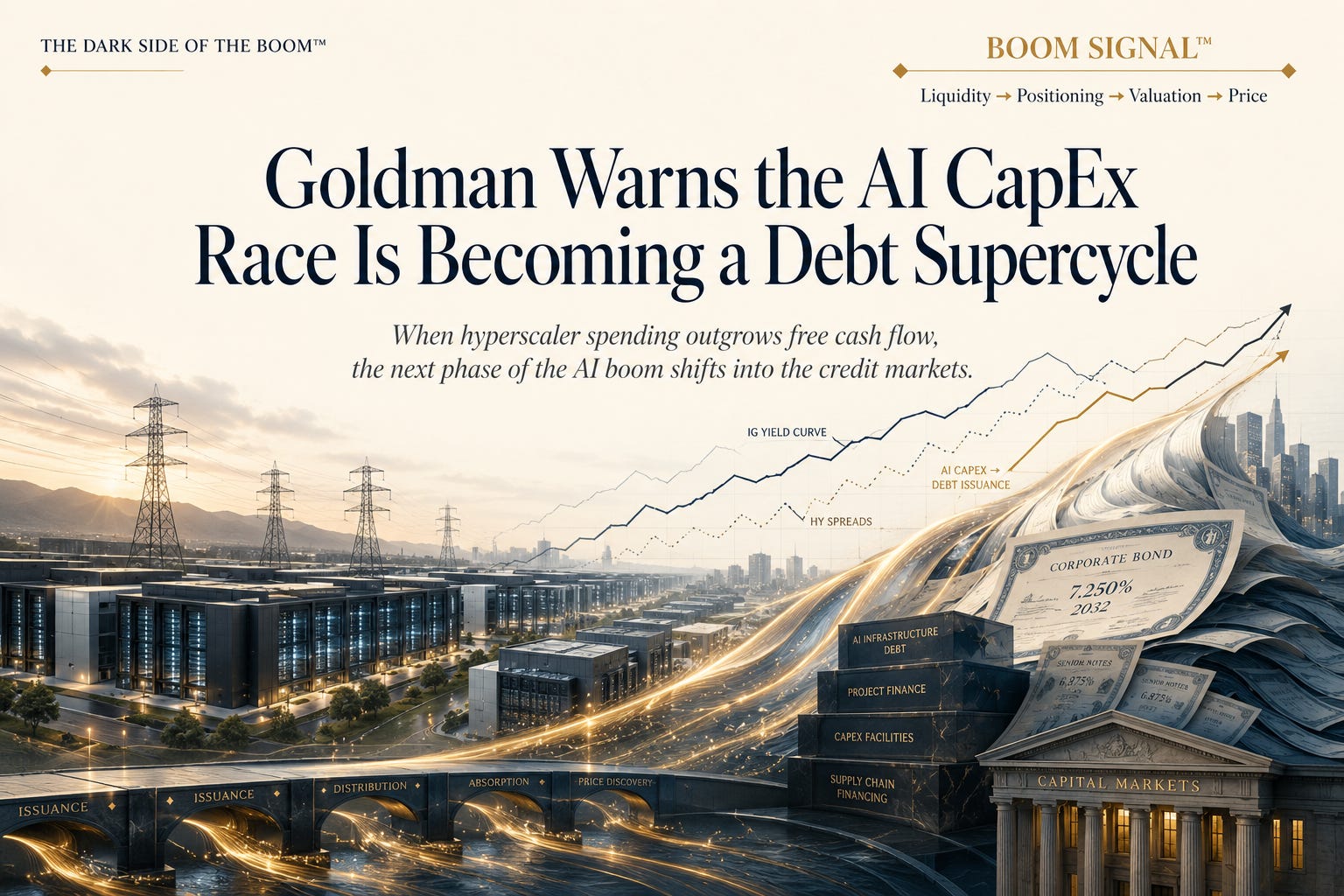
Goldman Sachs’ Amanda Lynam expects direct hyperscaler issuance to approach $400 billion in 2027, but the larger question is where trillions of dollars in AI financing can find a home once public bond markets reach their concentration limits.
Dark Side of the Boom Takeaways™
Goldman expects direct hyperscaler debt issuance to rise from roughly $250 billion in 2026 to around $400 billion in 2027, when debt financing reaches an estimated 35% of CapEx.
Between 2028 and 2030, the five largest hyperscalers may require approximately $1.3 trillion in additional CapEx financing, shifting more of the burden onto private infrastructure and project finance.
The group still possesses enormous borrowing capacity, but approximately $1.2 trillion of lease obligations makes the balance-sheet picture less pristine than conventional leverage ratios suggest.
The next phase of the AI trade will not be priced only through chips and equity multiples. It will increasingly be priced through bond concessions, index concentration, private-market liquidity and the cost of carrying infrastructure before monetization catches up.
The AI CapEx Race Is Becoming a Debt Supercycle
The first leg of the artificial-intelligence boom was financed with cash, confidence and some of the strongest balance sheets in corporate America. Hyperscalers could spend heavily, absorb the cost internally and still present investors with the financial profile of companies built more like fortresses than speculative growth machines.
That era is not ending, but the arithmetic is changing.