

Asia came in Monday carrying the bruises from Friday’s Wall Street close, with Japan, South Korea and Australia all softer from the bell and the MSCI Asia Pacific index lower as the technology selloff continued to work its way through the system. The Nasdaq 100 had dropped 3.5% on Friday, the Philadelphia Semiconductor Index was down 7.2%, Intel suffered one of the ugliest one-day moves in its history, and the VIX finally showed some teeth.
Takeaways by Dark Side of the Boom™
• The AI trade is being repriced from the inside out, with investors finally asking whether the core businesses funding the capex machine can keep carrying it while the payoff keeps moving further down the road.
• Oil is giving diplomacy some room, but Hormuz and the product complex are still trading a very different story from the flat price.
• Gold has finally found some dip buyers after Friday’s washout, but the NDX correlation is still fresh, oil remains the gatekeeper, and $4,082 is the first level that would make the rebound look like more than repair work.
• Across all three markets, the easy relationships are loosening. This is the sort of tape where price behaviour matters more than the story investors would prefer to believe.
Stocks — The AI Trade Loses Its Free Pass
Asia came in Monday carrying the bruises from Friday’s Wall Street close, with Japan, South Korea and Australia all softer from the bell and the MSCI Asia Pacific index lower as the technology selloff continued to work its way through the system. The Nasdaq 100 had dropped 3.5% on Friday, the Philadelphia Semiconductor Index was down 7.2%, Intel suffered one of the ugliest one-day moves in its history, and the VIX finally showed some teeth.
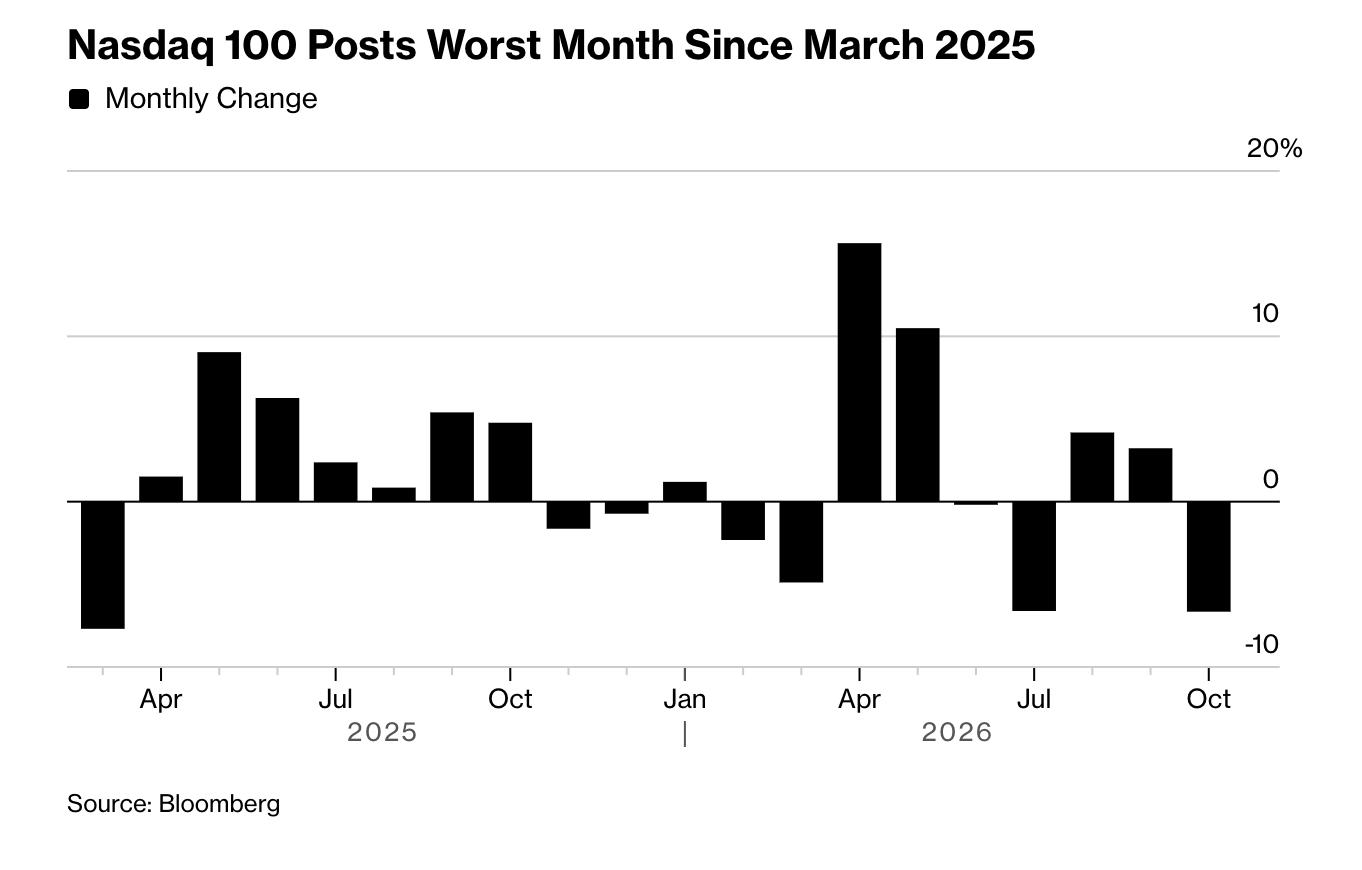
That is not pure index panic, but it is enough to change the conversation.
The AI trade has spent most of this cycle being rewarded simply for existing. Build the data centres, secure the chips, sign the power contracts, tell the market the payoff is coming later and the multiple took care of itself. That was fine while the businesses financing all of this were throwing off enough cash to make the whole exercise look almost self-funding.
Now that assumption is starting to look less comfortable.
The advertising, retail and consumer franchises sitting underneath roughly $750 billion of AI spending are showing signs of losing a little momentum, and that matters because the market is finally being forced to distinguish between AI demand and AI returns. Alphabet and Amazon have already pushed that debate into the open. Investors are no longer asking whether the technology matters; they are asking whether the spending has run too far ahead of the cash generation required to support it.
That is a very different question, and one the market has avoided for a long time.
The problem with a story built on deferred returns is that once the core business starts slowing, every new dollar of capex looks a little heavier. What was previously interpreted as proof of conviction suddenly becomes something the market wants justified line by line.
That is why Friday looked less like a routine wobble and more like a proper derating.
The breadth of the damage matters too. Rising correlations, heavier put demand and a volatility spike tell you this was not simply investors taking profits in one or two crowded names. The market started treating the AI complex as one trade again, and once that happens the liquidity characteristics change very quickly.
There is still a perfectly reasonable case that this is a clearing event inside a broader bull market rather than the start of something structurally worse. US futures have stabilised somewhat in Asia and the rest of the market is not behaving as if a systemic event has arrived. But the burden of proof has moved back onto the bulls.
Semis need to stop bleeding. The hyperscalers need to show that core earnings can keep financing the buildout. And the market needs to relearn the difference between “good enough” and “good enough at this valuation.”
China’s policy meeting on Monday may provide some support to the regional tape, but Beijing cannot fix a US technology valuation problem with a relending programme. (China’s Plunge Protection Team Regroups as Beijing Moves to Shore Up Stocks (Again)
The larger message is simpler.
The market has stopped paying for the word “AI.”
Now it wants the earnings.
Oil — Diplomacy Gets a Hearing, but Hormuz Is Still Trading War
Oil is giving diplomacy some room this morning, with Brent slipping below $112 and WTI near $102 after reports that President Trump wants to allow more time for negotiations before deciding whether to resume strikes on Iran after the midterms.
That is enough to take a little heat out of the flat price, but I would be careful about reading too much peace into the move.
Trump reportedly told Benjamin Netanyahu that he prefers diplomacy for now, while Rubio has said no decision has been made on new strikes. Tehran, meanwhile, is doing what Tehran does in these moments — talking through intermediaries while preparing for the possibility that the talks fail.
The tanker market is a better lie detector.
A vessel was reportedly struck in the Strait of Hormuz over the weekend after another attack on an LNG tanker Friday, and ships are still running dark in parts of the waterway. That does not look like a market that has returned to normal operating conditions; it looks like a market that has learned to function under threat.
That distinction is important because crude and products are telling different stories.
Gulf crude exports have largely recovered toward prewar levels, which is why the flat price can soften on a diplomatic headline. Refined products have not enjoyed the same normalisation, and that is where the real inflation signal still sits.
Diesel remains tight in both the US and Europe, refinery margins are still carrying a war premium, and the product complex continues to tell us that the supply chain has not healed simply because more crude barrels are finding their way through.
That is why I would not get too excited about a softer Brent screen.
The market can remove headline premium while still carrying physical stress underneath, and that is usually where the next repricing starts.
Goldman’s higher December Brent forecast fits that broader picture. The issue is less whether OPEC+ adds a few barrels around the edges and more whether the market remains one tanker incident away from losing another chunk of supply confidence.
OPEC+ holding December quotas unchanged almost feels like background noise at this point. The marginal barrel is being priced off war risk, refinery disruption and shipping confidence rather than another committee meeting.
For traders, the useful distinction is that oil is not yet rolling over because the fundamental story has broken.
It is rolling over because diplomacy has bought itself another few days.
If the talks improve and the tanker tape starts normalising, the market can take out more premium. If Hormuz remains dangerous and military rhetoric rebuilds after the elections, the premium will come back much faster than it left.
That has been the character of oil throughout this conflict.
Risk comes out slowly and returns violently.
Gold — Dip Buyers Are Back, but the Market Still Has Something to Prove
Gold finally found some buyers Monday after Friday’s washout, with bullion back near $3,900 after the previous session’s 3.7% drop took it to the lowest close in more than a year.
That is roughly where I expected the first strategic nibbling to start. Gold Weekly: When the Safe Haven Becomes the ATM
The important word is nibbling.
After a liquidation like Friday’s, central banks and long-duration buyers have no obligation to rescue the leveraged crowd on the first bounce. They can let the weak hands come out, watch the market settle and begin adding where the price starts to make sense again.
That is what this looks like so far.
Not a rush.
Not a stampede.
A few hands coming back into the market after the forced sellers have done some damage.
The difficulty is that October broke too many familiar relationships for gold traders to simply fall back on the old playbook. Real yields eased, equities weakened, geopolitical risk remained elevated and the dollar was not providing the usual headwind, yet gold still traded poorly.
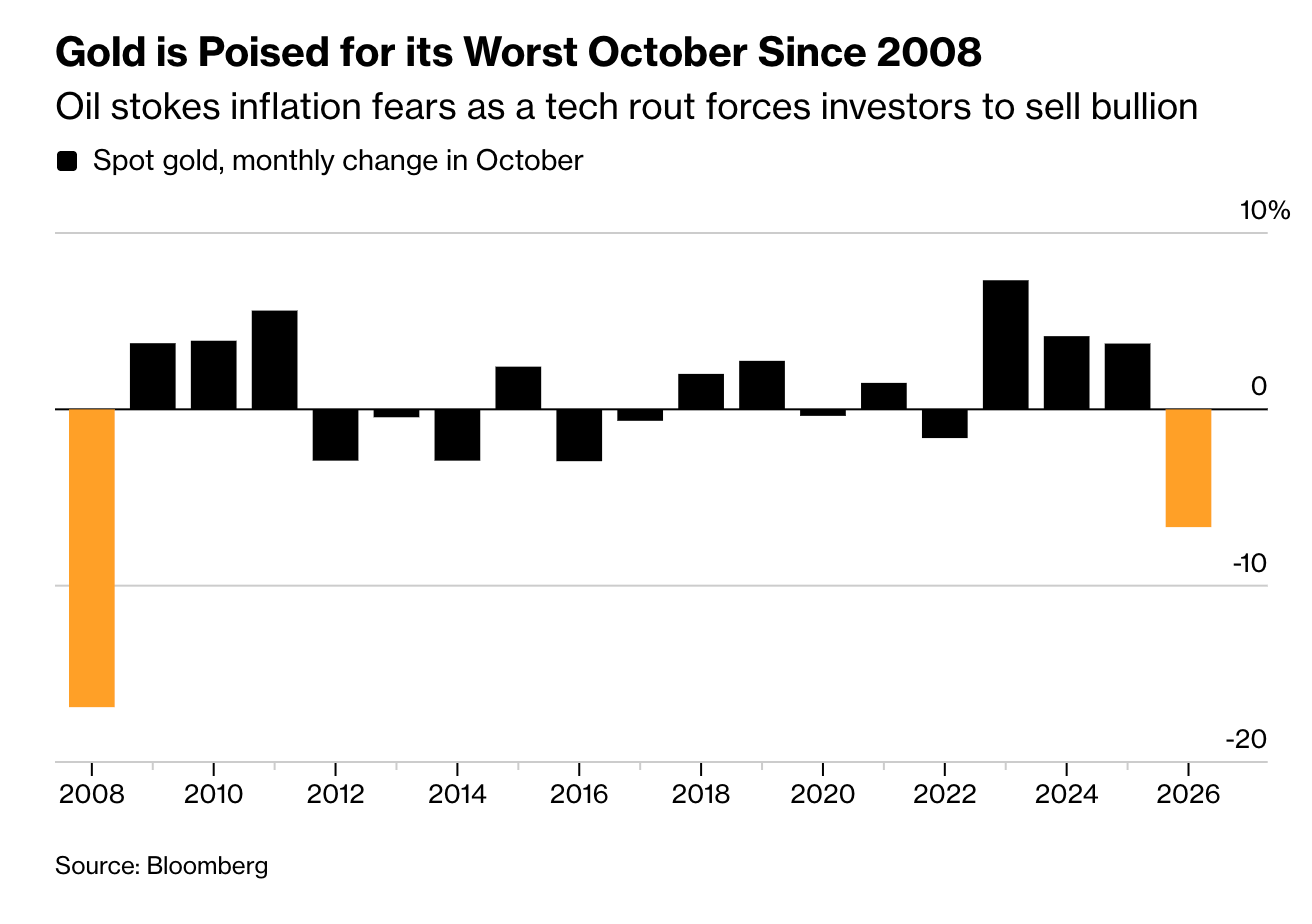
That was the warning.
Then came the more important move: bullion began trading with the Nasdaq rather than against it.
Once that happens, you stop thinking about gold purely as a hedge and start thinking about it as liquidity.
That is the scar tissue traders are carrying into this week.
If NDX sells off again and gold follows it lower, then the liquidation reflex is still alive and well. If NDX weakens and gold can finally hold, that would be the first sign that the market is starting to rebuild some independence from the tech complex.
Oil is the other piece of the puzzle.
Lower crude helps because it takes some pressure off the inflation channel and gives real yields a little more room to behave. But the last few weeks have shown pretty clearly that oil has become a gatekeeper for gold. If crude rebuilds its war premium, the inflation impulse starts fighting the geopolitical bid all over again.
That is why the current bounce still looks tactical rather than transformative.
The structural support is there. China remains one of the important official and retail buyers, reserve diversification has not gone away, and the longer-term case around central-bank demand and fiscal credibility remains intact.
But none of that means the market has to go straight up from here.
The technical damage still matters, and the first real test is $4,082.Gold’s $4,082 Question: UBS Sees a Market Short on Conviction, but Not on Buyers
Below that level, gold is still repairing.
Above it, the tone changes.
That would be the point where the market starts to show that Friday’s liquidation was a clearing event rather than the beginning of a deeper breakdown, and it would also tell us that some of the old relationships are beginning to reconnect.
Until then, I would treat the recovery for what it is.
A market coming up for air.
And that is really the common thread across all three markets this morning. AI is being forced to justify the money already spent, oil is waiting to see whether diplomacy can survive contact with the tanker tape, and gold is trying to prove that the first strategic buyers are enough to absorb the damage left behind by the leveraged crowd.
This is not the kind of tape where I want to force a grand narrative.
I want to see which markets can absorb bad news without making new lows.
That usually tells you more than the headline ever will.
We’ve seen this story with oil dozens of times. Bots fall for it everytime. It is in Trump’s interest to help Putin raise oil prices and oil revenue. Not sure why this is hard to understand. Gas prices have been subsidized because of the election. Spread between diesel and gas is at record highs. I guess gas prices are allowed to go up once the election is over.
The US Army is teaching soldiees to dig mass graves and have bases operate without supplies for 90 days. Mass graves. But tell me there is a chance for diplomacy. There could have been peace anytime over the last 8 months. Iran’s conditions haven’t changed. They remain the Gulf memorandum. Russia will help Iran kill US soldiers and help the Houthis blow up Saudi refineries. Russia benefits, Trump benefits from his investments in oil companies, everyone else suffers.